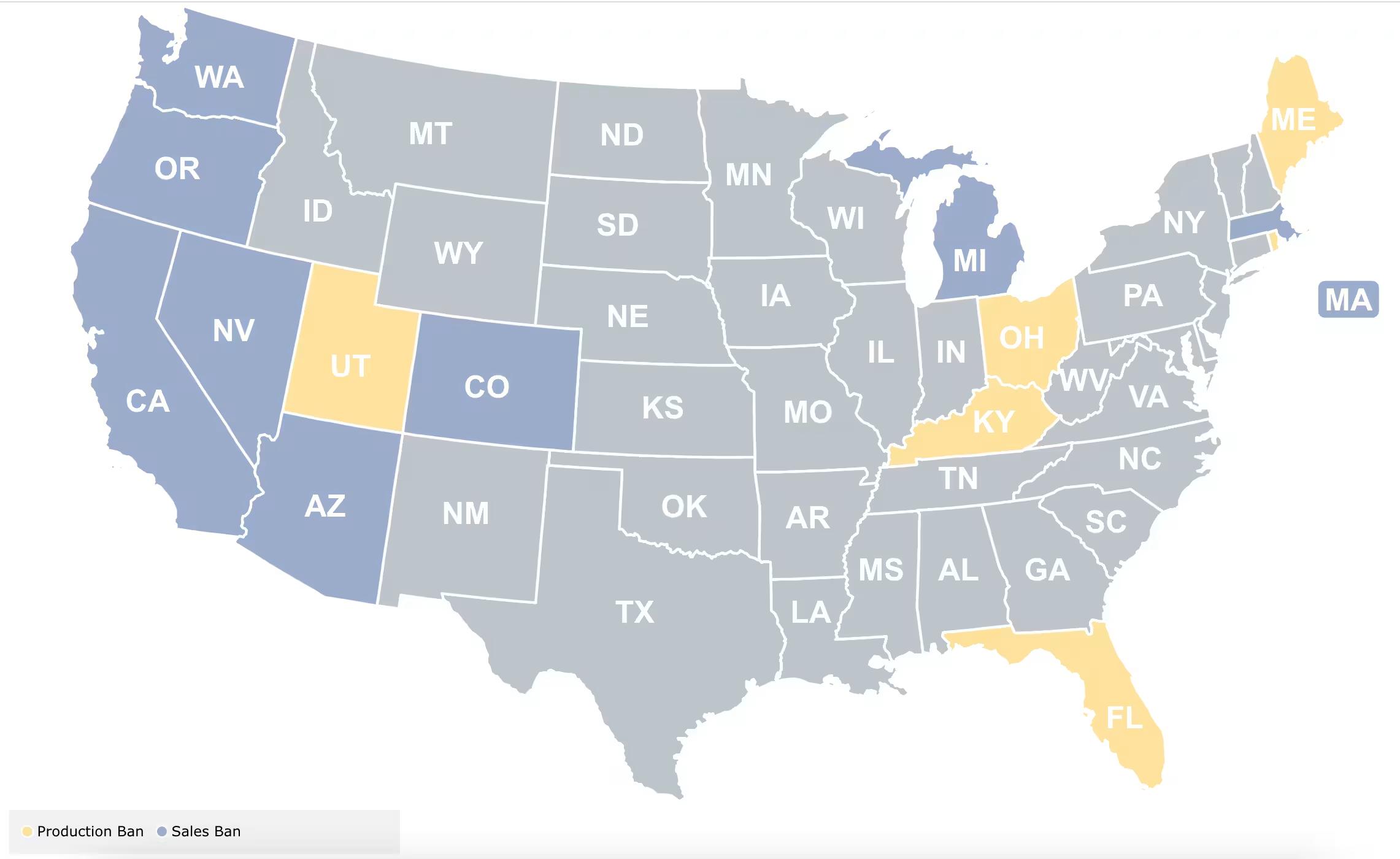
Along with taking aim at existing animal protection laws, the EATS Act and laws like it would make it nearly impossible to enact future legislation banning products that are a result of extreme cruelty. As our partners at Animal Equality explain, EATS would mean a “race to the bottom” in terms of conditions for farmed animals. With no regulations in place, meat industry abusers would be free to produce cheaper and cheaper animal products by the cruelest means possible—setting the bar lower and lower across the country.
The factory farming industry is willfully ignoring massive shifts in consumer preference, voting, and company supply chain decisions toward improved animal welfare. According to Data for Progress, 80% of US voters (split almost equally between the two parties) would support a law within their state like Proposition 12. Going directly against public opinion, the EATS Act would create a “hell on earth for animals, consumers, production workers and small and independent producers.” The threat it poses to our movement, and to the most basic human protections, cannot be overstated.
What are some of the animal protections threatened by the EATS Act and laws like it?
Laws at risk include:
What are the other dangerous implications of the EATS Act and similar laws?
The harms posed by the EATS Act, the “Protecting Interstate Commerce for Livestock Producers” (PICLP), and similar legislation go beyond animals. A recent report released by Harvard provides a detailed analysis of the EATS Act’s disastrous implications, building upon a similar report that analyzed the 2018 King Amendment. Beyond the incredible farm animal protections and confinement laws that we have worked so hard to pass across the nation, EATS would eliminate a wide spectrum of critical laws that fall under the definition of “agricultural product.”
The bill’s broad language (described as “vague and overreaching”) threatens many state laws that have been put in place to protect children, consumers, public health, and the environment. This is because the vague language included within the legislation’s text, like the phrase “preharvest production,” lacks a clear definition for us to rely on. This vagueness opens up significant questions of interpretation—and creates the potential to widen the scope of the types of existing and future laws that could be negatively impacted.
What types of laws and regulations will be negatively impacted if the EATS Act passes?
Food quality and safety regulations
A variety of state and local food safety regulations, designed to protect consumers and hold industries accountable, could be jeopardized if the EATS Act passes. These regulations could be prohibited under EATS if they place preharvest standards or conditions on agricultural products imported from other states. Furthermore, EATS would impact state and local government’s ability to regulate the usage of certain pesticides and fertilizers on crops.
Examples of food safety and quality regulations that could be affected by the EATS Act include:
- Manure management practices
- Restrictions on the use of antibiotics and growth hormones for farm animals
- Limitations on genetic engineering and other similar technological processes
- Soil and irrigation quality requirements
- Fluid milk quality standards
- Regulations regarding fish and shellfish sourcing
Horse slaughter laws
Federal regulations on horse slaughter are complex. Functionally, selling meat from horses across state lines is prohibited, because federal funds cannot be used to inspect the slaughter of horses. However, the in-state slaughter of horses for meat is federally permissible, as it falls under the “personal use and custom slaughter” exemption within the Federal Meat Inspection Act. While state bans on the wholly in-state slaughter of horses likely wouldn’t be affected, the EATS Act has the potential to prohibit states and localities from banning the importation of horses intended for slaughter for meat. Not only would EATS negatively impact horse slaughter laws; it would also affect standards regarding the animals’ transport and minimal welfare requirements.
One example of a law that could be affected is the California law that prohibits the importation of horses for slaughter for human consumption. California’s law places a preharvest condition on out-of-state agricultural products (i.e. a horse intended for slaughter) and therefore would likely be impermissible under the EATS Act.
Invasive pests and plant disease protections
Nearly every state has enacted laws regulating the importation of agricultural products that contain certain pests, invasive species, and diseases. The EATS Act could interfere with states’ historical right to enforce such regulations—and it could even prohibit an outright ban on the importation of agricultural products infested with invasive pests.
Under the Plant Protection Act of 2000, states are granted the ability to impose quarantines and regulations to prevent the introduction and spread of harmful plant pests like the glassy-winged sharpshooter and the emerald ash borer, even when no federal quarantine is in place. However, if EATS passes, states may no longer have the ability to protect their communities from the importation of products that contain those pests.
Labeling regulations
While there is a bit of uncertainty surrounding labeling requirements and the EATS Act, there is cause to believe that laws and regulations mandating or banning certain words or nomenclature on a product label could be prohibited if the regulation is conditioned upon a preharvest process. A broad interpretation of the EATS Act’s provision could lead to a prohibition on disclosing pesticide or chemical usage on agricultural products.
Furthermore, labeling laws regarding kosher and halal foods could be within the scope of the EATS Act—specifically, if the certified practices impose a welfare standard on the animal, or even on the types of equipment used on the animal prior to slaughter. Religious food labeling laws help ensure that consumers who follow particular diets are safe from injury and fraud. If EATS passes, these labeling laws and regulations intended to protect consumers could be severely disrupted.
Licensing, permitting, and recordkeeping requirements
States often impose licensing and permitting requirements for sellers and producers of agricultural products for a wide range of reasons—to ensure safety standards are met, to protect consumers from unfit products, or simply to track a supply chain of goods within their own borders. The EATS Act could strip states’ ability to oversee these permits and licenses for imported agriculture products, so long as those conditions relate to preharvest production.
State’s required recordkeeping for these imported products could also be affected by EATS, including records related to:
- Animal and plant health
- Sanitization
- Safety standards
- Production conditions
Narcotics laws
A variety of medicinal and recreational drugs fall within the broad definition of “agricultural products” that the EATS Act uses. Drugs of plant-based origin, in their raw forms, are included in that definition and therefore may be prohibited from state regulation. EATS may require states to permit the importation of certain drugs that are only banned at the state or local level, including any drugs that are currently under federal review. State regulation of certain agricultural products that go into vitamins and supplements are also at risk.
Procurement regulations
State and local procurement regulations are currently gaining momentum, with plant-based resolutions and procurement policies popping up across the nation. Unfortunately, EATS could also preclude purchasing restrictions that are interpreted as involving the preharvest production of imported agricultural products. Procurement laws that direct the purchasing conditions of public entities, such as local governments or school districts, could be prohibited.
Many states have enacted procurement policies to favor in-state producers while favoring products from women, minority, and veteran-owned businesses. If EATS passes, these preferences and policies could be voided.
Zoonotic and infectious disease regulations
One of the most significant areas of regulations that could be negatively affected by the EATS Act are state and local laws intended to prevent the spread of zoonotic and infectious diseases. Regulations regarding diseases such as avian influenza, salmonella, African swine fever, scabies, chronic wasting disease, equine infectious anemia, rabies, brucellosis, anthrax, and many more could be in jeopardy under the EATS Act.
Local producers who are protected by their state and local governments’ disease prevention policies and importation restrictions could see devastating effects to their livelihood if these laws are overturned. Importation restrictions and regulations for chickens and pigs—such as pre-entry veterinary inspections, permits, quarantines and testing—could be prohibited if EATS passes. Because of this legislation, the health and safety of humans and animals is under direct attack.
Fishing regulations
Fish and shellfish are considered an “agricultural product” under the EATS Act, regardless of whether they are farm-raised or wild-caught. If EATS passes, it could jeopardize a wide range of commercial and recreational fishing regulations designed to protect these species. Equipment restrictions, licenses to fish, and restrictions on fish and shellfish sourcing could all be prohibited via the EATS Act.
If passed, the EATS Act or any similar bill would take power away from cities and states, including state agriculture committees, to make decisions about what best serves their communities—and instead give that power to the federal government. The EATS Act’s sweeping implications would have far-reaching and disastrous effects on thousands of existing state and local laws, as well as these states’ ability to pass laws in the future. The most basic measures related to environmental protection, food safety, and public health (just to name a few) hang in the balance.
“Those industry executives who feel their trade is being “suppressed” (as the EATS Act’s name suggests) by laws like those regulating hazardous ingredients in food and using child labor might do well to remember that a free-market economy does not bestow upon any party or interest the unmitigated freedom to force immoral or unsafe products upon the public while ignoring voters’ reasonable concern for animals, public health, the environment, children and future generations.” —Kitty Block, President and CEO of the Humane Society of the United States, and Sara Amundson, president of the Humane Society Legislative Fund
What is the Animal Policy Alliance (APA) doing?
Our new Animal Policy Alliance (APA) is focused on driving policy change in the US to protect farmed animals. The APA equips local and regional animal groups across the country with the connections, research, and grants they need to create impactful legislation for animals in their own communities.
Needless to say, defeating the EATS Act and any legislation like it is a major priority of the APA and our members. Many of their wins are directly threatened: bans on the sale of dogs from puppy mills, bans on the sale of cosmetics tested on animals, and bans on the sale of force-fed foie gras. Their future work is threatened, too. Our team of legislative experts is working to fight this dangerous bill on all fronts, including partnering with APA members to mobilize and engage supporters across the country to defeat this bill.
How you can help
The factory farming industry wields tremendous power over policy makers at all levels of government. And to fight back, we need to unite across organizations, across movements, and across the country. If the industry thinks they can shut us down, they’re underestimating us. They’re underestimating you.
We need to ensure that Title XII, Section 12007 is kept out of the final 2024 Farm Bill by contacting our elected Representatives and Senators. Urge them to oppose any Farm Bill that includes Title XII, Section 12007, and any similar language, that would overturn elections and state agriculture laws.
Your continued advocacy is crucial! By working together, we can protect the animal protection laws we’ve fought so hard to establish. Let’s keep pushing for a Farm Bill that upholds the principles of democracy and protects our hard-won efforts in passing laws like California's Prop 12.