Indigenous communities fight factory farming injustice
Factory farming threatens Indigenous people’s communities and cultures. But, both in the United States and abroad, Indigenous people are standing up and fighting back against the forces that continue to exploit their land for profit.
 Amanda Waxman


Factory farming threatens Indigenous people’s communities and cultures. But, both in the United States and abroad, Indigenous people are standing up and fighting back against the forces that continue to exploit their land for profit.


Climate change impacts everyone. Every corner of the world feels its effects: from harsh heat waves, to endless droughts, to severe tropical storms. However, marginalized people feel its effects more harshly than others, particularly low-income people, people of color, young people, and people with disabilities. People with limited income now face the added pressure of widespread food insecurity, higher rates of disease, and even the possibility of their community becoming unlivable—all driven by climate change.
Sadly, those who will suffer the most from climate change are the least responsible for the crisis we are in. People in developing countries and low-income communities don’t produce carbon emissions anywhere close to the rate that huge, wealthy corporations do, yet they will be "the first to suffer" and, according to UN Secretary General Antonio Guterres, "the worst hit" by climate change.
Among those worst-hit are Indigenous peoples across the world. “Indigenous” refers to the people in any territory “who lived there before colonists or settlers arrived, defined new borders, and began to occupy the land.” These people continue to suffer the devastating impacts of colonization, which leave their communities without the necessary resources to withstand the economic and health impacts of the climate crisis.
In spite of these existential challenges, Indigenous activists are leading movements to protect their land, uplift their communities, and reclaim ecosystems from the destructive forces of big industries like factory farming.
Factory farming and Indigenous communities in South America
One of the clearest examples of climate injustice is unfolding in the Amazon region of South America. Indigenous tribes who have occupied the region for centuries are losing their homes and livelihoods, all so corporations can exploit their land for profit.
Factory farming and Amazon deforestation
The Amazon rainforest spans millions of acres of South America, stretching across nine different countries and thousands of Indigenous territories. To this day, the Amazon is home to some of the richest biodiversity on planet earth. Its warm, tropical climate provides the perfect habitat for species like gigantic flowering plants, tree-swinging primates, and vibrant blue butterflies who can’t be found anywhere else in the world.
However, these lush forests—and the species who call them home—are disappearing at an alarming rate. Areas that were once teeming with biodiversity now look like barren, lifeless wastelands, as companies clear forested areas and convert them for industrial use. This phenomenon, known as deforestation, has far-reaching consequences for the planet and everyone living on it.
Forested areas act as a carbon sink. Trees absorb and store excess carbon from the atmosphere, photosynthesizing it into the oxygen we need. When deforestation occurs, trees release their stored carbon dioxide into the atmosphere and lose their ability to absorb more of it. This toxic feedback loop contributes to the greenhouse effect, trapping heat in the Earth’s atmosphere and exacerbating global warming. Scientists point to the greenhouse effect as the main contributor to the climate crisis.
In spite of the long-term risks deforestation poses to our environment, huge industries continue to clear forests and exploit the land so they can post short-term profits. The meat industry is by far the biggest perpetrator of Amazon deforestation, as it converts forests into land for grazing livestock or growing livestock feed. In fact, environmental watch groups found that Brazilian meatpacking giant JBS destroyed over 100,000 hectares of forest for its livestock operations between March 2019 and March 2021. That’s over 185,000 football fields worth of tropical rainforest, all cleared to raise and kill animals for food.
The company pledged to remove deforestation from its supply chain by 2035, a pledge that most environmentalists call “grossly insufficient.” After all, JBS and other meatpacking companies have already done decades worth of irreversible damage to Amazon rainforests, causing species to go extinct entirely and degrading the soil to the point where nothing can grow in it. And, according to the United Nations’ latest report on climate change, we are “perilously close” to reaching irreversible climate change without swift, decisive action. Continuing to ravage the Amazon rainforest and drive further carbon emissions for over a decade is anything but swift and decisive, and it will have disastrous consequences on humanity as a whole.
Sadly, governments who have the power to regulate and punish companies that perpetuate deforestation refuse to stand up to the meat industry. Instead, some even actively encourage and embolden the meat industry to continue destroying forests for their own purposes. Such is the case with Brazilian President Jair Bolsonaro, who has actually called for further development of protected lands and the suspension of fines for companies who deforest these areas, including JBS.
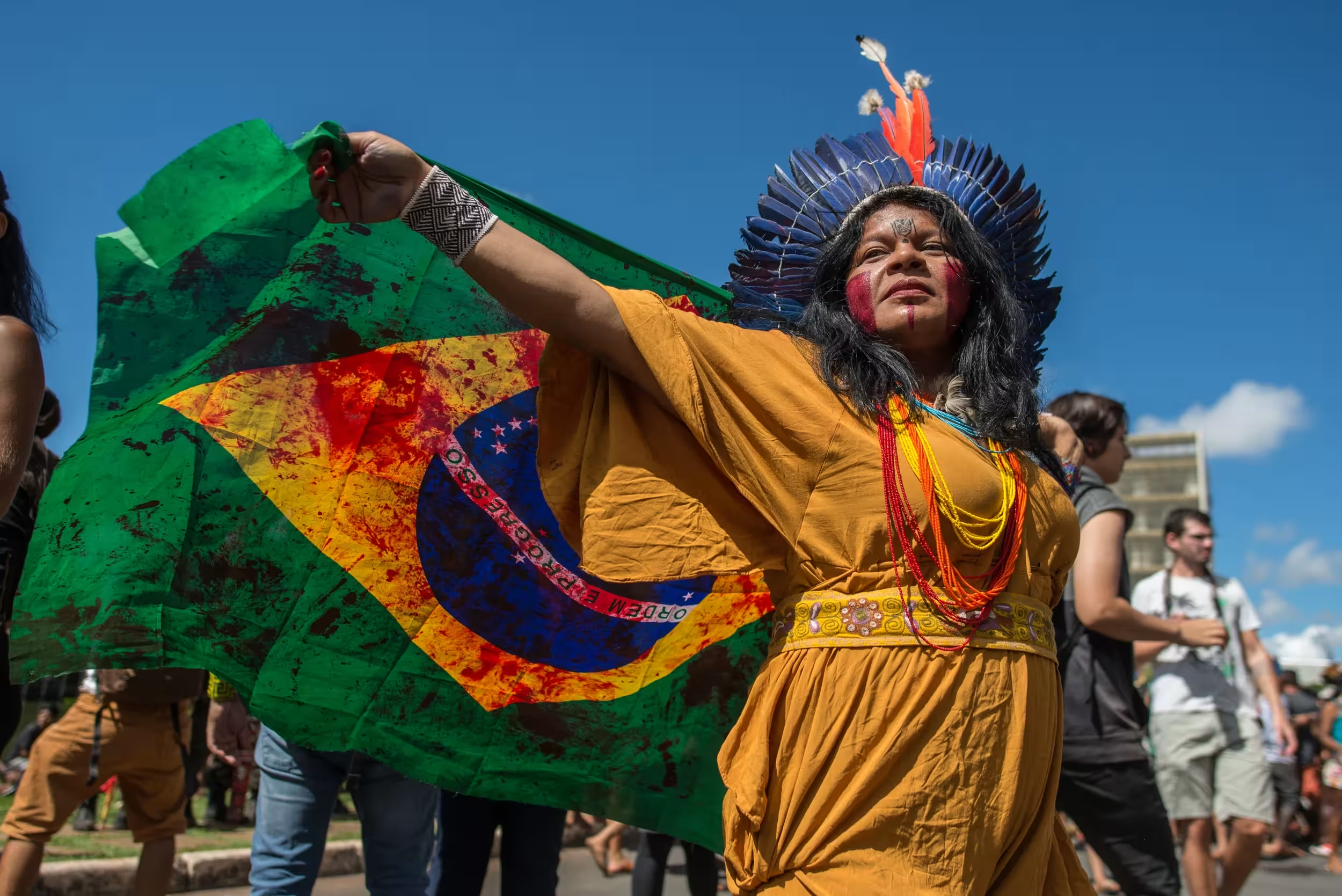
This places the responsibility of protecting forests on the shoulders of grassroots communities who depend on forest ecosystems for their survival—and Brazil’s indigenous communities have vowed to fight for their forests to the “last drop of blood.”
The human cost of Amazon deforestation
For centuries, over 400 native tribes have lived alongside Amazon rainforests, shaping ecosystems in a way that allows communities to use natural resources without overly compromising forested land. Thus, deforestation doesn’t just threaten forests—it threatens the very way of life of the Indigenous communities who rely on them.
“With each passing day, we see the destruction advance: deforestation, invasion, logging. We are sad because the forest is dying at every moment. We feel the climate changing and the world needs the forest,” says Handerch Wakana Mura, one of the leaders of the Mura Indigenous tribe in Brazil. Like many tribes in the region, the Mura people have seen protections stripped from their land as loggers and ranchers desecrate every last acre in pursuit of profit.
Traditionally, Indigenous tribes engage in farming practices that promote ecological resilience in the Amazon. Farmers cultivate useful crops alongside the natural vegetation, alternate crops, and add natural compost to enhance soil health, working with the natural ecosystem instead of against it. In contrast, outside companies that grow corn and soy for livestock feed clear the land entirely, creating “monocultures” where only one crop will grow for years at a time.
While this practice yields high amounts of livestock feed for the short-term, these monocultures exhaust and erode the soil over time. Deforestation makes soils that were once healthy and hospitable completely barren. Indigenous farmers rely on healthy rainforest soil to produce enough crops to feed their communities. When deforestation takes away this high quality soil, it can push Indigenous communities into hunger and food insecurity.
As deforestation threatens their food sources—and, by extension, their very survival—Indigenous communities have had to take matters into their own hands. While Brazil’s current administration erodes Indigenous land protections and allows deforestation to go unchecked, members of local tribes act as “forest guardians,” monitoring and protecting their lands from illegal farming, ranching, and other industry. These guardians are not just fighting for their own survival, but the survival of nature and the planet itself.
“The whole world needs fresh air and nature. This is our job, not only to save this territory but to help preserve nature in general,” says one of the leaders of Guardians of the Forest in Brazil. Researchers noted that Indigenous Brazilians with full ownership rights over their land saw a two-thirds decrease in the rate of deforestation, which translates to less carbon dioxide in our atmosphere and more protection against climate change. When Indigenous people succeed in their fight against deforestation in the Amazon, we all benefit from cleaner air and more livable futures.
However, these communities shouldn’t have to shoulder the responsibility of protecting the Amazon alone. As UN Secretary General António Guterres noted, these Indigenous communities contributed the least to the climate crisis we are in, yet they are left to fight on the frontlines against its worst impacts—a glaring example of climate injustice in action.
Although the Brazilian government could be doing more to protect forests, our own consumption habits in the US contribute to deforestation in the region. Much of the livestock grazing and feed grown in the Amazon goes toward feeding the global demand for beef and other animal products. While we continue to hold governments accountable, we can also show solidarity with Indigenous communities protecting Amazon rainforests by staying informed about where our food comes from and cutting down—or eliminating—our meat consumption. This shows industrial animal agriculture operations that consumers won’t support their destruction of forests—a crucial step towards climate justice.

Factory farming and Indigenous communities in the United States
In North America, Indigenous peoples have suffered widespread violence and exploitation since European settlers first arrived on the continent centuries ago. The harmful impacts of colonization can be felt in these communities to this day as they experience systemic economic and racial injustices. For example, the median income of Native American households is nearly $30,000 less than the median income of white households, and poverty rates in Indigenous communities are nearly double that of the rest of the country.
These populations can live in areas that are under-resourced and sometimes outright neglected by local, state, and federal governments, leading environmentally destructive industries to take over and further exploit Indigenous land. And, one of the most destructive industries in the United States is factory farming.
Factory farms house thousands of animals in one small space in order to maximize profits. This unnatural and intensive confinement of animals leads to vast amounts of waste, which seep into the surrounding environment. Communities living in the shadow of factory farms experience an unbearable stench emanating from cesspools of waste, as well as contaminated drinking water and pest infestations. In addition to destroying quality of life and property values in these communities, studies link factory farming pollution to higher rates of reported health conditions, including reduced lung function and asthma.
Researchers have extensively documented the destructive effects of factory farming on communities in North Carolina, the heart of the US pork industry. According to the Environmental Working Group, there are over 6,000 concentrated animal feeding operations (CAFOs)—the industrial term for factory farms—in the state. And, like other climate injustices, people of color and low-income communities suffer the most from the presence of these factory farms. This is especially true of Indigenous people, who are 2.18 times more likely to live within 3 miles of a factory pig farm than non-Hispanic white populations.
Indigenous communities don’t just suffer physical impacts from factory farming—factory farming harms their cultures as well. Some Native tribes incorporate soil, water, and other elements of nature into their sacred rituals. When factory farm pollution contaminates these vital resources, tribes are unable to perform traditions and ceremonies that are integral to their culture. Like in Brazil, big industry threatens Indigenous people’s very way of life, leaving them to fight to keep their cultures alive.
Fighting back
Like the forest guardians in the Amazon, Indigenous people in North America are working to protect their lands from economic interests who seek to exploit them. In the US, Indigenous groups are building a movement to grow, eat, and share food according to their own traditions and values. Instead of our current food system that exploits animals, workers, and the environment for corporate profits, these groups envision a food system built on “food sovereignty,” which nurtures healthy, interdependent relationships between farmers and the land.
The idea of food sovereignty highlights the fact that we don’t need factory farms to feed us—in fact, when considering all the environmental, health, and animal welfare implications, factory farms might ultimately do us more harm than good. We can feed and sustain our communities with healthy, local, plant-based foods, and a number of organizations are already doing the vital work of championing Indigenous food sovereignty. There’s so much to be gained by disrupting animal agriculture: not just for the animals but also for people around the world whose traditions, cultures, and histories have endured its horrors and, nevertheless, survived.
About The Humane League
We are a global nonprofit ending the abuse of animals raised for food.
Learn More
SUPPORT THE HUMANE LEAGUE


Already a sustainer? Manage monthly gifts


