Now it’s time to find out who kept those promises.
Our 2026 Eggsposé takes a close look at the foodservice provider industry—the sector responsible for feeding millions of people every single day in institutional settings—and tracks which companies have made meaningful progress towards eliminating one of the most extreme forms of cruelty in our food system.
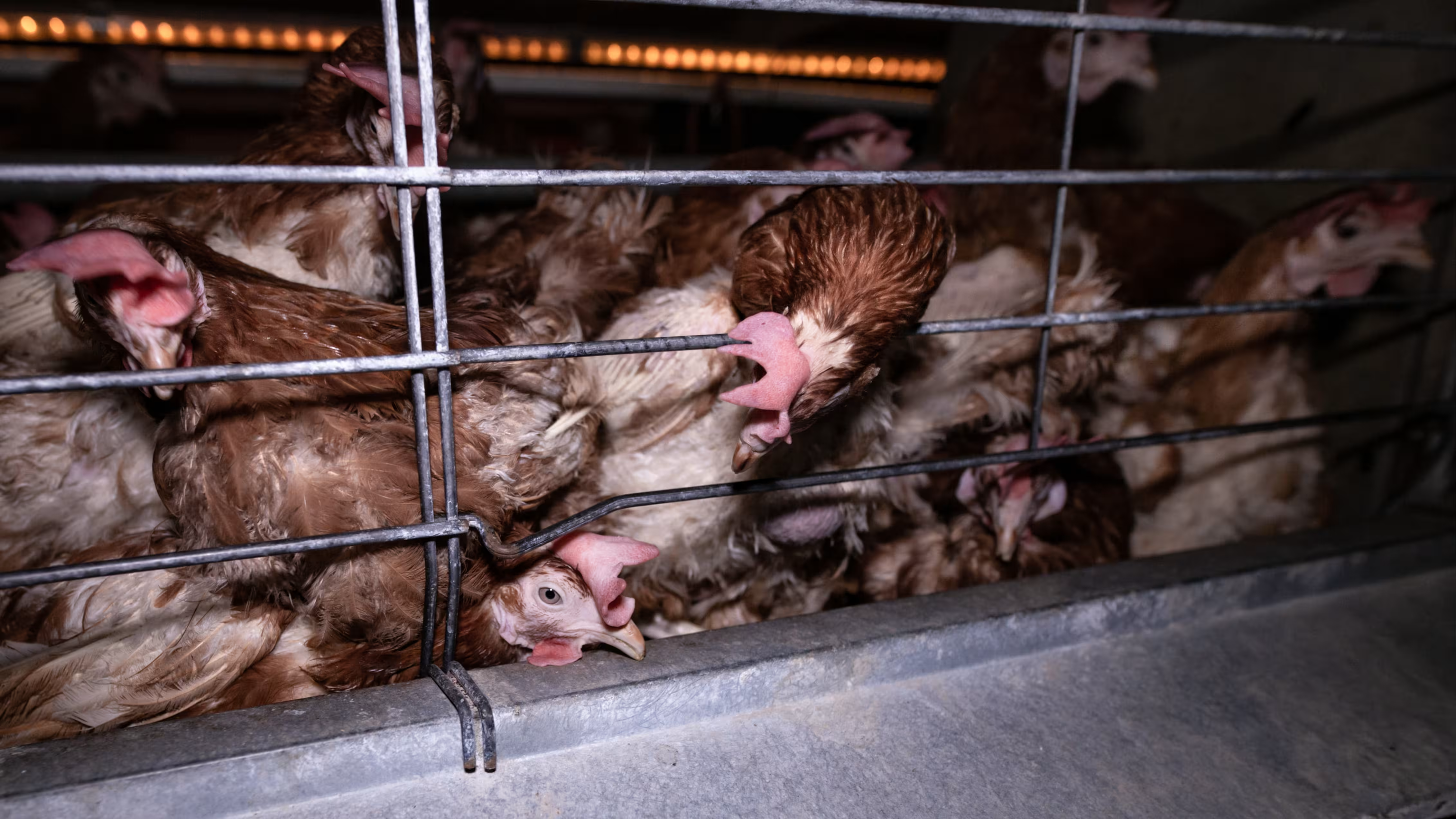
What life looks like in a battery cage
In a conventional battery cage, a hen shares a space roughly the size of a filing cabinet drawer with up to nine other birds. She can’t stretch her wings, perch, dust-bathe, or engage in any of the behaviors that come naturally to her. And she lives this way for her entire life.
This isn’t a necessary cost of feeding people. It’s a choice, one that companies make every time they sign a purchasing contract with an egg supplier. And it’s a choice that many of them promised, publicly, to stop making.
The companies that followed through
There’s real progress to celebrate here, starting with the companies that did exactly what they said they would.
Five foodservice providers have fully fulfilled their cage-free commitments and deserve recognition: Thompson Hospitality (100% cage-free since 2021), Whitsons Culinary Group (since 2020), HHS Culinary & Nutrition Solutions (since 2017), Creative Dining (since 2019), and Quest Food Management (since 2020). These companies proved that the transition is not only possible—it’s extremely doable. When companies are open about where they are and where they’re headed, it builds trust with consumers and clients. These foodservice providers are proof that when companies decide to do right by animals, they absolutely find a way to make it happen.
The companies that walked away from their promises
Then there are the companies that made commitments, only to erase them.
AVI Foodsystems, Guest Services, Genuine Foods, and Southern Foodservice have all removed their cage-free policies entirely. Not paused them. Not revised them. Removed them. OPAA! Food Management still has a partial policy on the books but has gone silent on reporting any progress towards eliminating battery cages from its supply chain.
These are public promises, made to the clients, students, patients, and fans these companies serve every day—and then abandoned. Each of these deleted policies represents real animals, hens who will spend their entire lives unable to spread their wings, turn around, or feel anything beneath their feet but wire. These companies looked at their customers and said: we’ll do better. Then they changed their minds and hoped no one would remember the hens suffering in their supply chains.
Why foodservice providers have fewer excuses than anyone
What makes the foodservice sector different from the rest of the food industry is predictability. These companies operate on long-term institutional contracts. They know, months and years in advance, approximately how many meals they’ll serve. This kind of stable, forecastable demand is exactly what egg suppliers need to be able to invest in cage-free infrastructure and offer competitive pricing.
During the 2022–2025 bird flu crisis, when egg prices spiked and supply chains buckled, companies that had already locked in long-term cage-free contracts were largely insulated from the worst of it. As Sherman Miller, President and CEO of Cal-Maine Foods (the largest egg producer in the United States) put it: “Customers consistently value consistency over spot pricing, and in an environment where volatility is the norm, reliability becomes a durable competitive advantage.”
As of early 2026, egg supply has recovered and prices have stabilized. We are currently experiencing one of the most favorable contracting environments in recent years. The window to lock in strong, stable cage-free supply agreements is open right now, which means that foodservice providers that act today can proactively protect themselves from the next disruption. Those that don’t will have only themselves to blame.
Clients and customers are already rejecting cages
The pressure to act is coming from the universities, hospitals, and corporate campuses that foodservice providers depend on for their contracts.
Student advocacy has pushed dining halls toward cage-free eggs at universities across the country. Stanford University’s Sustainable Food Ethos explicitly commits to food that’s healthy, fair, and humane. One in three hospitals in the US is part of the Health Care Without Harm network, and the latest sustainability data show that 51% of member hospitals are already purchasing animal products that meet higher welfare standards.
On top of this, cage-free laws have now been passed in 10 states, including California, Massachusetts, Colorado, Oregon, Michigan, Washington, Nevada, Utah, and Rhode Island. No state has repealed a cage-free law, and proposals are advancing in additional states. For foodservice providers operating across multiple states, failing to transition to cage-free systems could create compliance risks. In fact, 63% of egg-laying hen farmers support cage-free laws. The remaining 38% preferred not to answer. Not one respondent said no.
The cage-free transition isn’t coming. It’s here. The laws are on the books, the farmers are on board, and the institutions these companies serve are writing their values into their contracts. The only foodservice providers still looking for reasons to wait are the ones who haven’t yet decided that the animals in their supply chains are worth the effort.
What you can do
Your voice is what moved this industry in the first place. Corporations don’t change because it’s the right thing to do—they change because people like you make animal cruelty impossible to ignore.
You can take action right now:
Reach out to the foodservice providers that removed their cage-free commitments and let them know you noticed. Contact the institutions they serve—the universities, hospitals, and arenas—and ask whether their vendors’ values align with their own. And share this report with anyone who eats food served by these companies, which is to say: almost everyone.
The hens living in these cages don’t have a voice in the boardroom. But you do. And together, we can push decision-makers to do the right thing.


 Liz Fergus