Why Does the Dog Get the Couch But The Chicken Gets the Cage?
A viral cosplayer becomes a dog. A model becomes a chicken. Behind the body paint, a conversation about which animals we choose to love—and which we forget.
A viral cosplayer becomes a dog. A model becomes a chicken. Behind the body paint, a conversation about which animals we choose to love—and which we forget.
With more than 7 million followers across platforms (Facebook, Instagram, TikTok, YouTube), the Southern California–based content creator and cosplayer has built a massive audience by doing what they love: transforming into characters so convincingly you have to look twice. From Demonslayer to Walter White, Aragorn to Nebula, Predator to Molly Weasley—Jo lives for that “wow factor,” that moment when the before and after makes you stop mid-scroll.
But their latest transformation isn’t pulled from a movie franchise or an anime series. It’s something much more personal—and deeply powerful.
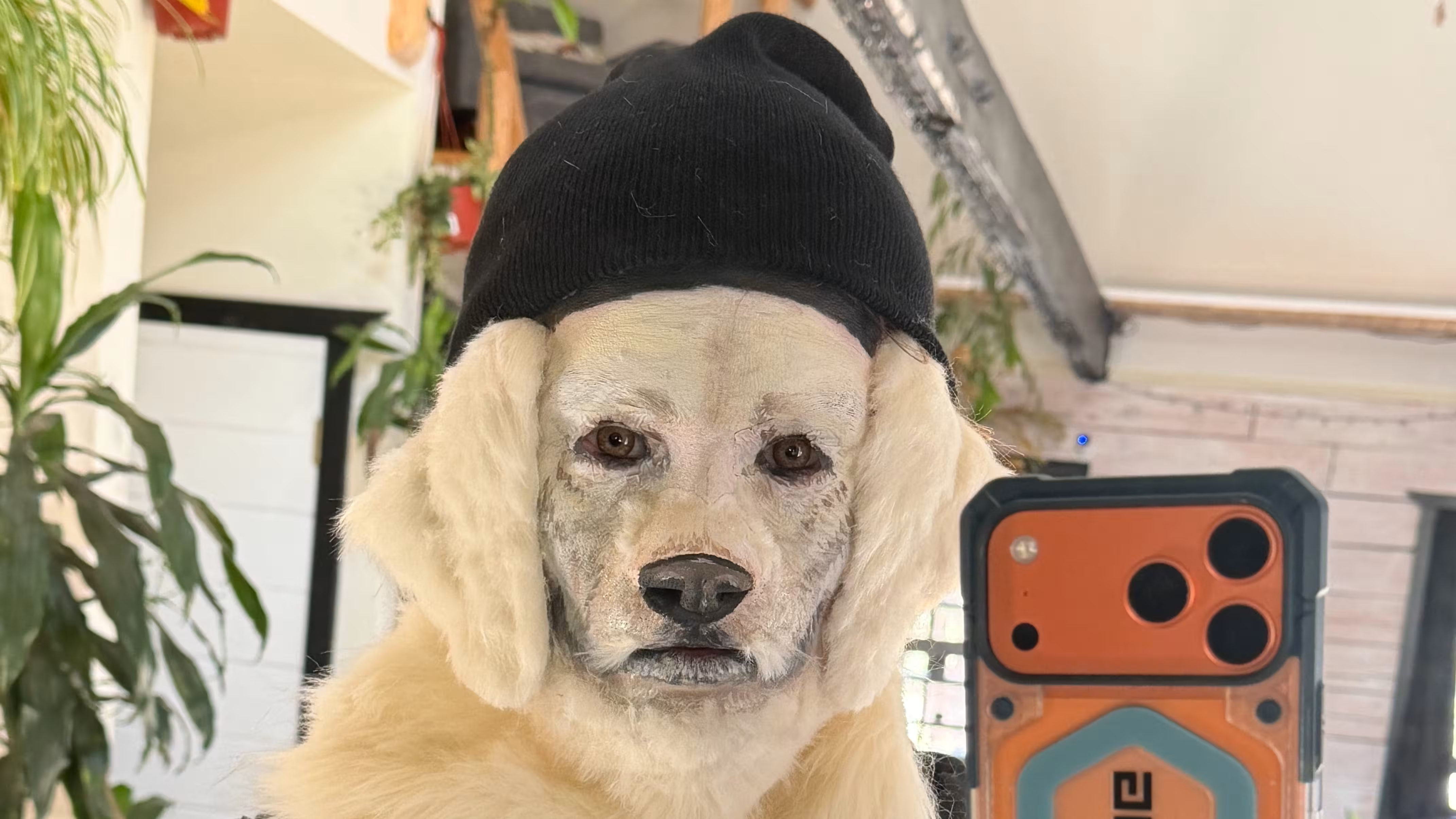
Working alongside Jennifer J. Cheung, a Korean American actress and model, Jo painted Jennifer as a chicken while transforming themselves into a dog. Side by side, they became two different animals—one we’re taught to love and one we’re taught to overlook. The visual is striking. The question it raises is even more so: why do we treat them so differently?
We caught up with Jo and Jennifer behind the scenes to find out what drew them to the project—and what they hope you’ll take away from it.
The artist behind the art
If you haven’t fallen down the Jo Steel rabbit hole yet, now’s a good time.
Jo got their start in content creation while working at a special effects studio, but they first went viral back in college while studying film production—drawing portraits on their legs. That landed them on the front page of The Boston Globe, CNN, Reddit, and the Steve Harvey talk show. Things never really slowed down from there.
Today, Jo is a full-time content creator and cosplayer who creates promotional content for film and television. They’re also a self-described “huge nerd”—someone who’s played Dungeons & Dragons for 10 years, was introduced to anime through Dragonball, and remembers Fullmetal Alchemist as their first fandom obsession. When they’re not in front of a camera or covered in body paint and prosthetics, you might find them doing jiu jitsu, kickboxing, lifting weights, going skydiving, or off-roading in their Jeep named Spooky. Oh—and at home, Jo shares their life with 5 cats, 4 dogs, and 2 pigs, all rescues. Jo is also in recovery from the removal of a Grade 2 Oligodendroglioma (a low-grade malignant brain tumor) and was gracious enough to tackle an ambitious chicken-and-dog transformation to support our global campaign against CJ Group, while also sharing personal reflections on animals, art, and advocacy.
“We’ve been conditioned from birth”
For this collaboration with Jennifer, Jo didn’t just show up with brushes and pigments. They showed up with something to say.
As someone with a house full of animal companions—dogs, cats, and pigs—Jo has spent years thinking about the way society draws lines between the animals we love and the animals we eat. During the behind-the-scenes filming of the transformation, Jo shared the personal reckoning that so many of us are familiar with: “We’ve been conditioned since birth to view dogs as our companions, but we view chicken as food.”
Jo is the first to acknowledge that none of this is anyone’s fault: “You have restaurants that are named after chickens being food, so I don’t think it’s anybody’s fault that they feel this way, but I do think we need to view them the same and we have to recognize that they feel similarly, like they can feel pain, all of these things. So once you kind of lock that in, I think you’ll start to see them as family the same way that we feel our dogs are our families.”
Jennifer, meanwhile, has her own theory: “Dogs evolved alongside us, so that bond is incredibly strong,” she said. “Dogs can move their eyebrows and empathize with us and can read our emotions, whereas chickens, I don’t think, have had as much of an opportunity to read our faces.”
As a devoted cat owner, she's familiar with people dismissing bonds with animals who don’t behave like dogs—and that the same dynamic plays out even more dramatically with chickens. “Everyone’s always comparing everything against the standard of being a dog—and chickens are not dogs.”
Personalities, bonds, and easy-to-ignore realities
When asked whether it surprised them to learn that chickens form social bonds and have individual personalities—just like dogs—Jo and Jennifer each responded with candid honesty.
Jo has been learning about the inner lives of animals for years. “Personally, I wouldn’t be so surprised because I have been kind of learning these things over the course of a decade, but I do think other people might be surprised that they have individual personalities. Once again, the more we assign individuality to animals we’ve been conditioned to think are food, I think the more uncomfortable it is. So I totally understand why some people might not want to recognize this, but the reality is that they do.”
They added that they personally dream of building a home for chicken companions someday: “People form bonds with their chickens all the time and it’s a bond I hope to have one day when I can build my chicken companions their worthy home. So it’ll take a little bit of time to get there, but I’m very excited to become friends with some chickens.”
Jennifer’s response was equally revealing. She admitted that the idea of chickens having individual personalities didn’t surprise her—but their capacity for social bonds did, at least at first. “I think that we’re just trained to focus so much more on our companion pets than we are other pets,” she said. “I think it’s surprising that chickens have their own personalities and form social bonds, and that as a society we don’t really look at them that way because they’re not companions usually, and they have been a huge source of food for, I think, generations. And we’re at a point where, in developed countries, there’s no food crises here, and so it’s a responsibility to be more ethical around other creatures and the earth.”
What if it were dogs?
At one point during filming, the conversation turned to a question that cuts right to the heart of the matter: What if dogs faced the same conditions that chickens face in factory farming?
Jo didn’t hesitate.
“If dogs endured the same kind of conditions that factory farm chickens do, there would be, you know, mass public outrage. And I think it’s about time we extend that empathy towards chickens because I think by and large, they’re really forgotten about. And there are so, so millions and millions and millions of chickens every year endure horrors. We should really extend that outrage for them because they are thinking and feeling living beings, so they deserve to have our empathy.”
Jennifer’s answer was just as pointed. “I think that hens deserve the same care as dogs because they are beings too,” she said, “and it’s our responsibility as the most intelligent being to take care of beings around us.” Reflecting further, she shared: “As a society that’s now moving into AI and so advanced in that regard, it is a little barbaric to think that we don’t treat animals with the kindness that we would treat dogs—or ourselves, frankly.”
Why Jennifer wanted to be a chicken
When asked why she wanted to be part of this project, Jennifer was honest. “The opportunity presented itself and I didn’t want to take for granted the ability to make an impact, actually,” she said. “I have been this year actually seeing a lot of things that have pointed towards thinking more responsibly about what we consume, how we consume, and how we source things.”
She paused, then added with a grin: “On the whimsical side, I want to see how I look as a chicken.”
Jennifer also offered a more serious version: “I wanted to be a part of this project because I love animals and hens are animals and I want to advocate for their health and safety.” She reflected, “I'm not even a huge fan of hens, I’ll admit. But it’s going to be interesting to be turned into one and to see myself as a hen. You know, maybe we all should be seeing ourselves as the animals that we consume or interact with.”
A word we should all learn
During filming, both Jo and Jennifer considered the word speciesism—the idea that we place certain species above others, often without thinking about why. Jennifer admitted she’d never heard the term before.
“I actually had never heard of the word speciesism,” she said. “And it just makes me think that, again, we need to be all thinking thoughtfully about what we’re doing.”
It’s a reaction many of us can probably relate to. We may not have a word for it, but we’ve all felt it—that uneasy sense that the lines we draw between “pet” and “not pet,” between “deserving of love” and “just food,” aren’t as solid as we’ve been taught.
Why Jo and Jennifer are having this conversation now
Their collaboration arrives at a pivotal moment. In 2024, South Korea’s National Assembly unanimously passed a law banning the dog meat trade—a landmark decision that recognized dogs as living beings who deserve protection from cruelty. The ban, which takes full effect in 2027, signals a profound cultural shift in how a nation thinks about the animals in its midst.
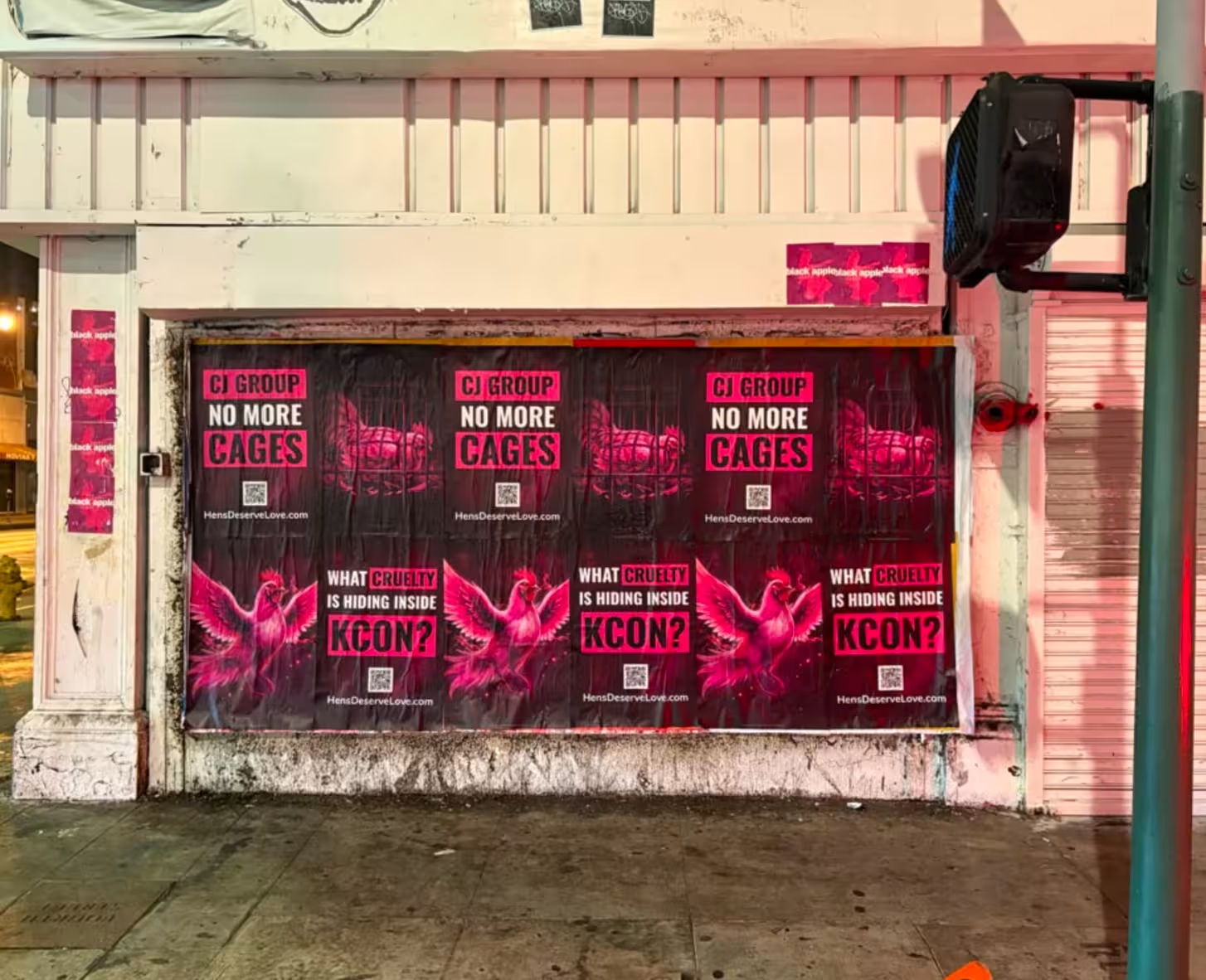
But while South Korea took a historic step for dogs, roughly 60% of the world’s egg-laying hens are raised in Asia—many of them trapped in cages so small they can barely move. South Korea has issued a ban on conventional battery cages, to come into effect in 2027, but egg farmers could instead default to enlarged cages—slightly bigger cages that still keep birds confined in a state of constant agony. What this means is that food businesses need to spearhead the push to 100% cage-free, bypassing half-measures like enlarged cages. Right now, CJ Group, the massive Korean conglomerate behind beloved brands like bibigo, TOUS les JOURS, and the cultural convention KCON, sources millions of eggs from hens confined in cruel cages. Thousands of major food companies around the world—from Starbucks to Jollibee to Kewpie—have already committed to spare hens from cages. CJ Group has not.
Jennifer didn’t hold back when it came to CJ Group's responsibility. “If you're in a position where you have a lot of power, you really have a huge responsibility to act responsibly. Whether that be to your fellow human being or a dog or a hen. I think that profit motivation is very dangerous.”
She was equally direct about what the company should do: “Bibigo and CJ Group should use all cage-free eggs because they can probably afford it. And it’s the right thing to do. If I had a corporation that I was running, I would not in any way want it to exploit anything or anyone, even if that might lower my profit margins. And I certainly wouldn't want to be known as propagating cruelty.”
Jennifer’s participation in this project as a Korean American carries a special resonance. This is a conversation that bridges cultures, connects communities, and asks an urgent question: If we’ve recognized that dogs deserve freedom from cruelty, shouldn’t we extend that same recognition to chickens?
A transformation that goes deeper than paint
The visual concept of this collaboration is deliberately simple: a dog and a chicken, painted side by side on two people. But the message underneath is one that lingers.
Jo summed it up beautifully: “If viewers could take one thing away from the transformations today, Jennifer as a chicken and me as a dog, I hope that it’s, you know, similarly to the process that you view today, I hope that they can view both dogs and chickens similarly too, as animals, as living beings who could feel fear and pain and who both deserve to have our empathy and who deserve to live fulfilled lives while they have them.”
As for Jennifer, she shared: “I hope that more than anything, it just makes people think at all. Because it’s very easy and tempting to turn our brains off altogether and just follow the flock and just do what everyone else is doing mindlessly. You've been blessed with your own mind and your own critical thinking skills—so please use them, and decide if it’s right for animals to be caged in terror.”
How you can help
Jo and Jennifer’s transformation shows us that the way we see animals can change—and when it does, everything can shift. If this resonated with you, here’s one thing you can do right now:
Tell CJ Group it’s time to end cruel cages. Send a message urging CJ Group to make a global commitment to spare hens from cages. It takes thirty seconds—and every message makes this truth harder to ignore.


 Julia Tomkins Wisner