Yet one of the most important stories was just starting, largely out of sight, in a room in Copenhagen. That’s where a transformative plan was being hatched, asking a then-radical question: What if the key to ending the abuse of chickens worldwide wasn’t one organization, working alone, but a global coalition, working together?
It was a bold—and boldly collaborative—idea, to be sure. But it was premised on a few sturdy facts: Most of the world’s egg-laying hens are kept in battery cages—small wire enclosures used in industrial farming to maximize efficiency (and profits). Battery cages provide each bird with less space than a single sheet of paper—making it impossible for them to spread their wings. Yet every animal should have the right to perform their natural behaviors—and every language has a word for compassion.
Ten years later, that fledgling idea has grown from a group of six animal-protection organizations into a force of 80+ groups across 70+ countries. The Open Wing Alliance (OWA)—founded in 2016 by The Humane League (THL) to unite global animal advocacy groups, eliminate battery cages, and close skill gaps through shared training and resources—has become the strategic key to transforming our global food system. To date, the OWA has secured more than 3,000 commitments to animals, distributed more than $14 million in grants, and built a collective network of activists from Thailand to Colombia, Poland to Rwanda.
Step by step, bird by bird, more and more OWA groups and people are refusing to accept that cruelty is inevitable. Working together, we’re unlocking a future where every hen can spread her wings.
Setting the stage
To understand how far we’ve come, it’s helpful to look back.
In 2016, public concern over battery cages was starting to grow. Hundreds of major food brands were announcing plans to phase out conventional battery cages, often setting target fulfillment dates a decade away. Yet the real-world, real-time gap between these corporate commitments and the actual conditions on the ground was enormous.
Battery cages can cause severe health problems, from physical ailments such as osteoporosis, bone fractures, feather loss, and painful foot and claw injuries to psychological issues such as chronic stress, intense frustration, and depression-like states. Invented in the 1930s, battery cages have been the default infrastructure of modern factory farming since the ’50s. In 2016, in the United States, just 10–15% of hens were cage-free, according to the US Department of Agriculture (USDA).
But while the groundwork for a better tomorrow was being laid, the movement lacked a unified, globally coordinated engine to turn promises into reality. Fortunately, that was about to change.
The following OWA highlights show the breadth, scope, and depth of the alliance’s work over the past 10 years. It’s a selective collection that illustrates how much the OWA has accomplished already—and flicks at how far we still have to go.
A decade of courage, compassion, and grit
2016: A global spark in Copenhagen
When The Humane League founded the Open Wing Alliance, working alongside pioneering animal-protection groups on six continents, the challenge was immense.
“When we discussed the idea in Copenhagen, we were up against two things,” recalls David Coman-Hidy, who in 2016 was THL president and executive director. “The obvious one was the international egg industry. They have massive resources, political power, and inertia on their side. The second thing was infighting: In many regions, organizations were competing instead of coordinating, duplicating efforts at best, fighting at worst. That atomization was sapping our collective power. Together, we wanted to find a different way to move forward based on collaboration, openness, and a shared goal.”
THL began backing OWA partners with strategic grants and campaign trainings—and notching immediate wins. In Denmark, founding member group Anima secured cage-free pledges from every major supermarket chain just months after it received an OWA grant. Elsewhere, mobilizing as a unified front, the OWA coalition won landmark global commitments from massive corporations such as the Compass Group, Aldi Nord, InterContinental Hotels Group, and Lidl.
“What makes me think ‘We can do this!’ is the passion and commitment of OWA members,” says current THL CEO Dan Shannon. “Every time I’ve met one of these activists, I’ve come away inspired by the lengths they’re willing to go to in order to end the use of cages—and how clear-eyed and pragmatic they are about the real work it will take to do that.”
2017: Uniting for global impact
In February 2017, the OWA held its inaugural Global Summit to End Cages in Warsaw, Poland. Advocates from 17 organizations and 22 countries gathered to share tactics and launch the alliance’s first coordinated global campaign, targeting General Mills. Just two weeks later, the food giant committed to a global cage-free policy.
“That first campaign showed us how much power we have as a united front,” says THL’s Ellie Ponders. “It opened the door for more hard-hitting and increasingly ambitious global campaigns.”
Simultaneously, Baltic OWA partners Dzīvnieku brīvība (in Latvia), Tušti narvai (Lithuania), and Nähtamatud Loomad (Estonia) secured cage-free commitments from retailers that control more than 70% of the Baltic market combined. “That win set the foundation for cage-free work in the Baltics,” says THL Vice President of Programs Alex Suchy, adding that international solidarity provided crucial backing when local groups faced legal threats.
Aivars Andersons, CEO of Dzīvnieku brīvība, agreed: “Not only has the OWA provided collaboration opportunities and practical support at every step. It has also inspired us to dream big and go for maximum impact for the animals.”
2018: Expanding horizons, challenging giants
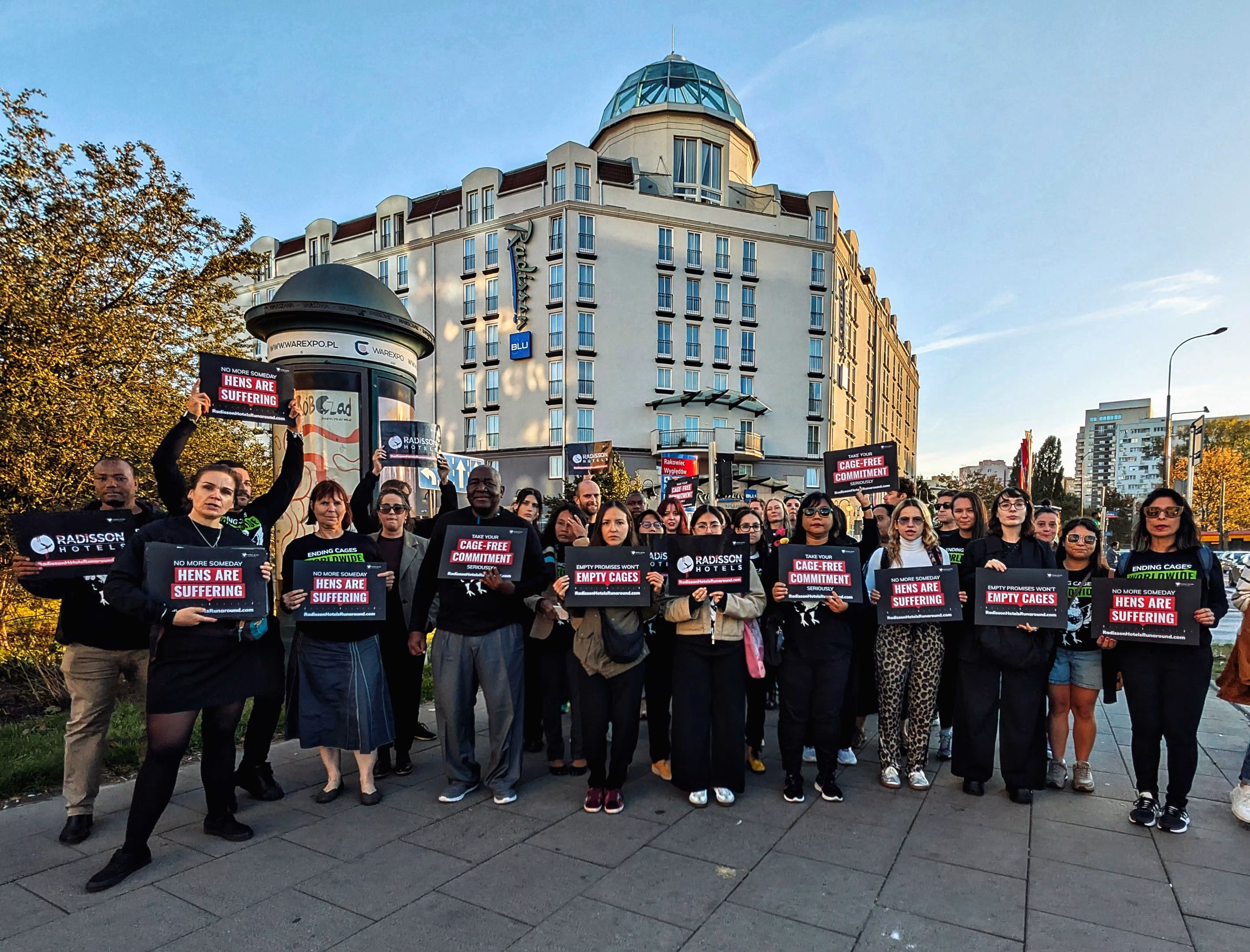
By 2018, the alliance had expanded to 59 organizations. At the OWA Summit in Prague, 115 activists from 40 organizations in 43 countries gathered for four days of hands-on training, networking, and strategic planning. They also joined a historic global protest outside Starbucks, demanding the coffee giant adopt a worldwide cage-free policy.
Over in Asia, the OWA joined forces with Environment & Animal Society Taiwan (EAST) to negotiate a milestone cage-free commitment with Carrefour Taiwan at Carrefour’s Paris headquarters—the first major retailer commitment in Asia. Perhaps even more amazing: Carrefour Taiwan has since become a champion for animal welfare, installing educational videos in store aisles, building in-store cage-free display zones, even releasing an interactive mobile game to raise consumer awareness.
2019: Resilience amid adversity
At the third annual Global Summit in Warsaw, 140 activists from 46 countries honed their digital campaign strategies. The coalition put these virtual tactics to work immediately, launching simultaneous international campaigns that successfully secured global cage-free policies from major hotel chains Best Western and Hilton.
2020: Proving the power of global pressure
When COVID-19 began disrupting global supply chains and travel, the OWA adapted swiftly. Despite ongoing pandemic restrictions, OWA activists rallied across Russia, Taiwan, Denmark, Turkey, Sweden, Finland, and Indonesia to take on Restaurant Brands International (RBI), the parent company of Burger King, Popeyes, and Tim Hortons.
“Many groups were not yet campaigning [due to COVID],” says Ponders. “If [the coordinated RBI protest] went badly, it might have led to continued hesitation.” It did not go badly, however. Instead, more than 270,000 petition signatures, plus thousands of direct calls, spurred RBI to commit to a global cage-free policy.
“That win gave energy and belief to the entire alliance,” says Ponders. “It showed that we could, and should, dive back into campaigns. Because we can win them!”
That same year, persistent OWA-backed campaigning led the City Lodge Hotel Group to announce the first-ever cage-free commitment by an African hotel chain.
2021: The largest victory yet
The OWA achieved its biggest victory to date when Yum! Brands—the world’s largest fast-food conglomerate and the parent company of KFC, Pizza Hut, and Taco Bell—pledged to eliminate battery cages across nearly 50,000 locations in 150 countries. Yum! Brands had initially resisted US policy changes, but relentless, coordinated global pressure from OWA activists proved overwhelming. When it finally stepped up, it set a new benchmark for the entire industry.
2022: Breaking ground in Japan
One way to test a coalition’s limits is to launch a campaign in a conservative or politically difficult market. Which is what the OWA did in 2022 when it launched its first campaign against a Japanese-headquartered multinational corporation: TORIDOLL.
The resulting global cage-free commitment covered more than 1,000 restaurants across 27 countries. Perhaps even more importantly, it established a crucial precedent while showing that Asia’s corporate food sector was ready to transition away from cages.
2023: Momentum in Asia and Africa
Building on this momentum, the OWA secured a global cage-free commitment from the Jollibee Foods Corporation—Asia’s fastest-growing restaurant group—that spared more than 2 million hens each year.
In Africa, where factory-farm expansion threatened to trap millions of birds in imported battery cages, a collaborative, continent-wide effort commenced when 23 OWA member groups across 11 countries pushed back. One of them was the South African multifaith environmental justice organization SAFCEI (Southern African Faith Communities’ Environment Institute), which celebrated as Famous Brands fulfilled its global cage-free commitment three years ahead of schedule, improving conditions for nearly 200,000 hens.
As Animal Welfare League (AWL) veterinarian Dr. Daniel Abiliba said, “The OWA provided many resources on tactics, and the opportunity to share our experiences with a community of advocates.”
2024: Winning over Asia’s egg giants
In 2024, the OWA targeted Kewpie, Japan’s iconic mayonnaise manufacturer and one of the largest egg consumers in Asia. After intensive campaigning and negotiations, Kewpie, which buys 4 billion eggs each year, released a cage-free policy for its Asian markets that spared an estimated 700,000 hens annually. It also agreed to invest in regional cage-free impact incentives, as a way to help accelerate farm transitions.
2025: Benchmark victories
In 2025, the OWA global summit united 82 member organizations across 72 countries, securing 216 new cage-free policies and investing more than $2 million in grants across 30 countries. With regional summits across Africa, Asia, and Latin America, the OWA also helped 48 member groups build local strategies.
At the same time, Nando’s South Africa became the first restaurant brand on the continent to reach 100% cage-free egg sourcing across its operations.
Meanwhile, Sweden officially achieved a complete market phaseout of battery cages through corporate fulfillment and public advocacy, thereby demonstrating that systemic food shifts can happen even ahead of legislative mandates.
2026: Local leadership drives global change
This year, an investigation by the Latvian OWA group Dzīvnieku brīvība prompted AGROVA—the second-largest egg producer in the Baltics—to announce a 100% cage-free transition by 2028, which will impact 164,000 hens.
In Latin America, OWA regional strategy workshops helped AnimaNaturalis (in Colombia) and Fundación Derecho y Defensa Animal (Chile) step up to co-lead a major campaign targeting the region’s largest airline, LATAM Airlines. Simultaneously, Arcos Dorados, the world’s largest independent McDonald’s franchisee, issued a happy report: More than 95% of the fresh eggs served at McDonald's across Latin America are now cage-free.
The Power of the Collective: Looking Ahead
One thing became clear over the past decade: The Open Wing Alliance functions as a force multiplier. By connecting local grassroots passion with global campaign strategy, training, and microgrants, the OWA has helped independent organizations around the world win victories and make changes that once seemed impossible.
Which is why, as the OWA turns 10, it’s important to note that the engine driving this process is you—our member organizations, campaign partners, donors, volunteers, and digital advocates. You make us go. Whether you signed a petition, joined a protest, or funded a crucial grant, your dedication has built a movement capable of shifting entire global supply chains. The OWA has proved its approach is the most effective way to change the world for the greatest number of animals.
In retrospect, 2016 looks like an inflection point. Many of the major corporate pledges that shape today’s discussions about farmed chicken welfare were set in motion during that pivotal year.
Since then, cage-free egg production has expanded substantially across multiple continents. Yet progress remains uneven. While thousands of companies have made public commitments, implementation often lags behind scheduled timelines.
All of which is to say that 2016 was less a year of completed reforms than a year in which the blueprint was drawn. A decade later, the OWA foundation is solid. Our global alliance is stronger than ever. And we’re just getting started.